
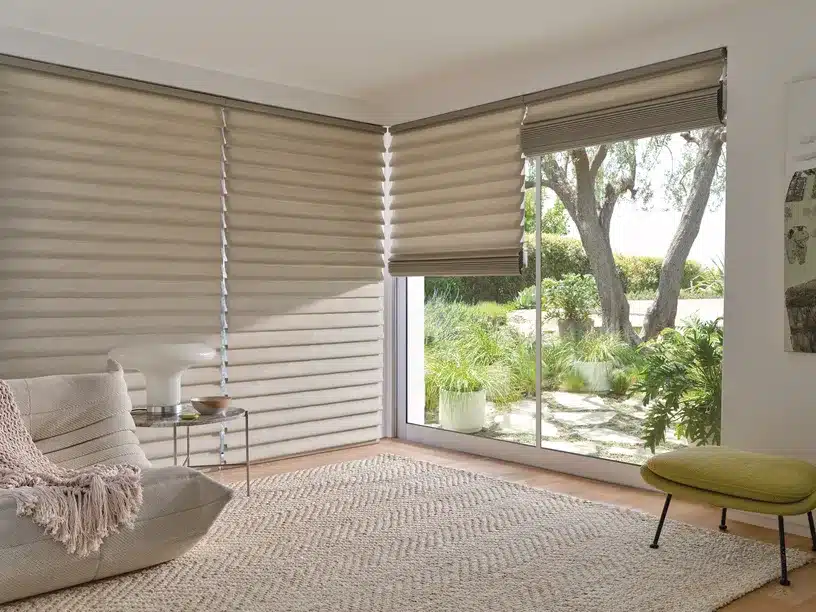
Roman shades are a single panel of fabric that folds up into soft, horizontal pleats as you raise them and lies smooth and flat against the window when lowered. They give you the warmth and style of a curtain with the clean, tailored operation of a shade — no slats, no stacks of hanging cords. If you want fabric at the window without the fussiness of drapery, Roman shades are usually the answer, and here’s everything worth knowing before you choose one.
What are Roman shades?
A Roman shade is a window covering made from one continuous piece of fabric that draws upward into evenly stacked folds and drops down into a flat, seamless panel. Unlike blinds, there are no tilting slats — the whole shade raises and lowers as a unit — and unlike cellular or roller shades, the fabric is the star, so Roman shades read as a soft, designer-grade treatment. They come in flat, hobbled and modern rolling styles, in light-filtering or room-darkening fabrics, and with cordless and motorized lifts.

The three Roman shade styles
How Roman shades work
Behind that fabric panel is a series of horizontal rods or seams. As you raise the shade, the fabric gathers along those lines into stacked folds at the top; as you lower it, the panel unfurls flat. That’s the whole trick — and it’s why Roman shades look so architectural compared with a bunched-up curtain.
Because it’s all fabric, a Roman shade insulates and softens sound better than a hard blind, and it hides the mechanism entirely. Modern versions like Hunter Douglas Vignette® Modern Roman shades take it further by rolling the fabric into the headrail with no exposed cords on the back — cleaner to look at and safer around kids.

The pros of Roman shades
- Designer looks. The widest fabric, color and texture range of any shade — they set a room’s tone the way art does.
- Softness & warmth. Fabric absorbs sound and softens hard rooms in a way slats never will.
- Clean, uncluttered operation. The whole shade moves as one panel — no rows of slats to dust, no tangled cords with cordless and modern styles.
- Insulation. A fabric panel — especially with a room-darkening liner — adds a layer at the glass that a bare blind doesn’t.
- Layer-friendly. They pair beautifully under drapery or over a light-filtering shade for a custom, finished window.
The honest tradeoffs
- Fabric needs gentle care. You dust or vacuum on low and spot-clean — no wiping down like faux wood. Keep them out of steamy bathrooms and over the kitchen sink.
- Stacked fabric at the top. When fully raised, the folds sit as a stack that covers a few inches of glass — worth knowing on a view window.
- Big windows get heavy. On very wide openings, a single fabric panel is a lot of material; sometimes two shades or a different product is the smarter call.
- Side light gaps on inside mounts. Like any inside-mount shade, a little light sneaks around the edges — an outside mount or a room-darkening upgrade fixes it.
Light control: filtering vs. room-darkening
Roman shades come in two broad fabric families. Light-filtering fabrics glow softly and keep daytime privacy while letting the room stay bright — ideal for living and dining rooms. For bedrooms and media rooms, choose a room-darkening fabric or add a blackout liner, which blocks far more light behind the same look. Many styles also offer top-down/bottom-up operation so you can let light in up high while keeping privacy down low.
Roman shades vs. cellular and roller shades
They’re easy to mix up, so here’s the quick sort. Cellular shades win on pure energy efficiency — their honeycomb pockets trap air — and cost less, but they’re a more utilitarian look. Roller shades are the simplest and most minimal, rolling to a slim tube. Roman shades sit above both on style: choose them when the window is part of the room’s design and you want fabric to do the talking. Not sure which room wants which? Our guide to window treatments by room lays it out.
In practice, Roman shades earn their place in the rooms you want to feel finished — living rooms, dining rooms, primary bedrooms and home offices. They’re a natural fit in the older colonials and newer builds across Northern Virginia, where a fabric shade warms up big double-hung windows without the weight of full drapery. If you’re local, our guide to window blinds and shades in Fairfax covers which treatments suit which rooms.

See Roman shade fabrics in your own light
Fabric is the finish and the function — so see it on your window first. Book a free in-home consultation and Nation’s Blinds will bring samples across Northern Virginia, DC & Maryland.
Frequently asked questions
What is the difference between Roman shades and blinds?
Roman shades are a single panel of fabric that folds up as it raises, while blinds have hard, tilting slats that adjust light without lowering the whole covering. Roman shades offer a softer, more designer look and better insulation, whereas blinds give more precise, adjustable light control at a lower price.
Are Roman shades good for bedrooms?
Yes. In a room-darkening fabric or with a blackout liner, Roman shades block significant light and add insulation, which makes them well suited to bedrooms and media rooms. Cordless and motorized lifts add safety and convenience for everyday use.
Can Roman shades be used in kitchens and bathrooms?
Roman shades can work in kitchens away from the sink and stove, but because they are fabric they are best kept out of steamy bathrooms and direct splash zones, where moisture and grease are hard to clean. In wet rooms, faux wood blinds or moisture-friendly shades are usually a better choice.
What are the different styles of Roman shades?
The main styles are flat or classic Roman shades with crisp tailored folds, hobbled or looped Roman shades with soft rounded cascades even when down, and modern rolling Roman shades like Hunter Douglas Vignette that roll into the headrail with no rear cords. All come in light-filtering or room-darkening fabrics.
Do Roman shades come cordless or motorized?
Yes. Roman shades are available with cordless lifts for a clean, child-safe look and with motorized options, including PowerView automation, for tall or hard-to-reach windows. Nation’s Blinds can show the lift options during a free in-home consultation.


